

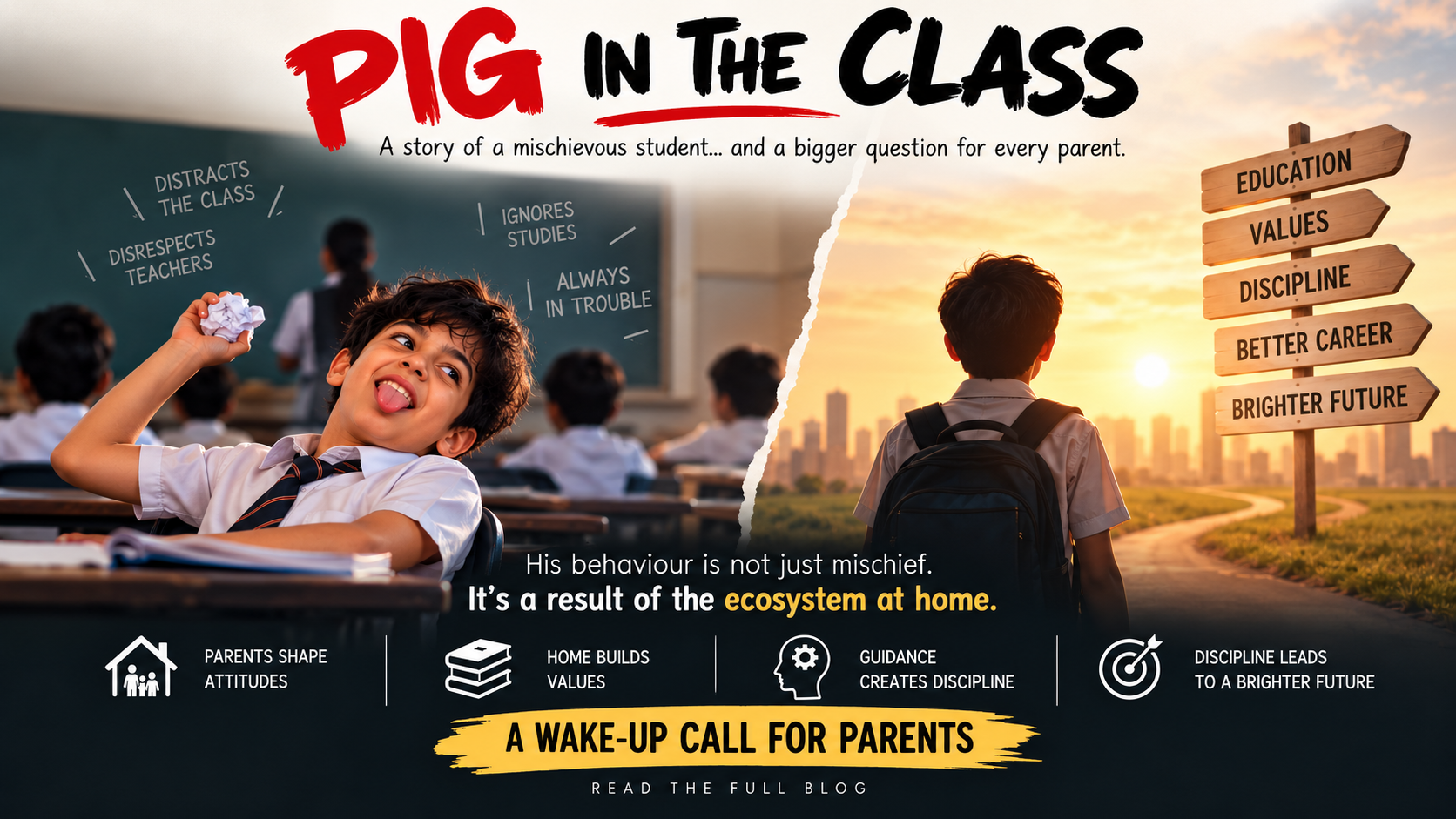
In almost every school, there is one student who becomes famous for all the wrong reasons.
Let’s call him Rohan.
Among students, he has a nickname: “Pig in the Class.”
Not because he is dirty.
Not because he is bad at studies.
But because he creates chaos wherever he goes.
He interrupts lessons.
Mocks teachers.
Distracts others.
Turns serious learning moments into jokes.
At first, everyone laughs.
But slowly, the laughter fades. And a deeper question emerges.
Why does a child become like this?
Most people assume such children are naturally naughty.
That assumption is lazy.
Children are not born disruptive.
They are shaped by their environment.
When we looked deeper into Rohan’s life, a pattern appeared.
At home:
Education in that house was treated like a school’s responsibility, not a family responsibility.
The result?
Rohan entered school without the ecosystem needed for learning discipline, curiosity, or respect for education.
So the classroom became his stage.
Children seek attention.
If they cannot get appreciation for learning, they will get attention through disruption.
Rohan learned something early:
If he cracked jokes, everyone laughed.
If he disturbed the class, everyone looked at him.
And slowly he became the performer of the classroom.
But here is the dangerous part.
The behaviour that gets applause at age 12 becomes a liability at age 25.
Parents often underestimate how quickly academic damage accumulates.
For students like Rohan:
By the time the child reaches Grade 10, the consequences explode.
Subjects become difficult.
Confidence collapses.
Blame starts shifting everywhere.
Parents say:
“School is not teaching properly.”
Teachers say:
“He never pays attention.”
The truth?
The problem started years earlier.
Discipline and learning ability are the foundation of careers.
Without them, choices shrink.
A student who spends years joking in class usually struggles with:
These are not “school skills”.
They are life skills.
When such students reach adulthood, they face a harsh reality:
The world does not reward class clowns.
It rewards problem solvers, thinkers, creators and disciplined learners.
Behind the mischief, many such children eventually experience:
Ironically, the same student who once laughed in class may later say:
“I wish someone had guided me earlier.”
Here is the uncomfortable truth many families avoid.
Schools teach subjects.
Families shape attitudes toward learning.
If a child grows up in an environment where:
The child automatically begins to value learning.
But if the home environment is dominated by:
The child absorbs those priorities.
Children do not follow advice.
They follow environment.
Many parents dismiss early warning signs.
They say things like:
“Kids are like this only.”
“He will improve later.”
“Boys are naughty.”
But these small behaviours are early indicators of deeper problems.
Warning signals include:
These are not personality traits.
They are signals that the child lacks the right learning ecosystem.
One of the biggest mistakes parents make is waiting too long.
They wake up only when:
By then, the habits are already deeply formed.
Correcting behaviour at age 16 is far harder than guiding it at age 10.
Parents who raise disciplined and curious learners usually focus on three things.
Education is visible in the house.
Books. Discussions. Curiosity.
The child grows up believing learning matters.
They observe patterns.
They correct disrespect and laziness before it becomes habit.
Instead of guessing, they use:
This helps align the child’s strengths with education and career planning.
Instead of blaming the school or the child, parents should ask themselves:
“What ecosystem have we created for our child’s learning?”
Because the truth is simple.
A classroom does not create a “Pig in the Class”.
A neglected learning environment does.
Every mischievous student is not a problem.
But every child who consistently rejects learning is sending a signal.
A signal that something in the ecosystem is missing.
Guidance. Structure. Inspiration. Discipline.
Parents who ignore these signals risk something far bigger than poor marks.
They risk their child drifting through life without direction, purpose, or confidence.
And by the time the realization comes, the lost years cannot be recovered.
Education does not fail children.
Neglect does.
And the responsibility to prevent that neglect begins at home.
 Whatsapp
Leave a Reply
Your Email address will not be published